
Guide – Buzzy Joell
Windhoek – Okonjima
We left Windhoek and began the scenic drive north to Okonjima – The home of the Africat Foundation. We made a quick stop for coffee in Okahandja to discuss what was in store for us for the next 48 hours. After all we had Leopard tracking, Pangolin tracking and several game drives and night drives to look forward to.
After arriving in the mid afternoon, we settled into our rooms, then went down to the waterhole situated in front of the lodge to see what would visit. Springbok, Common Duiker, Steenbok, Warthog and Common Impala all made an appearance.

As the sun began its journey west, we grabbed warm clothes and climbed onto our open game drive vehicle, it was time for our first activity, Leopard tracking!
Okonjima has a few collared Leopards that are used for research purposes. This gives us an opportunity to track these incredible animals and hopefully get a sighting of one.
However this is Africa, this is wildlife and it’s not a zoo. We unfortunately couldn’t find a Leopard, the male Leopard whose signal we picked up was on the move and gave us the slip for the better part of 2.5 hours. It absolutely amazes me that even with the help of modern technology we still couldn’t find this elusive cat. We did get wonderful sightings of Black backed Jackal, Steenbok, Common Duiker, Oryx, Common Impala, Springbok, Hartman’s Mountain Zebra, Plains Zebra, Greater Kudu, Warthog and Blue Wildebeest.
We headed back to the lodge for dinner and to hopefully get a call that our next activity was a GO.
Pangolin tracking… I cannot recommend this activity enough [*]. As is with everything; sightings are not guaranteed, but it’s your best bet to see these incredibly rare animals.
We had literally just taken our last mouthful of dinner when our guide appeared to tell us we had the green light! Dessert would have to wait…
We headed off into the African night.
We parked the open vehicle, what greeted us after a short walk through the bush was a 13-week-old Pangolin. Let me just explain that, as a guide, I get to experience some incredible things in the bush – but THIS rockets straight into my top 5 experiences ever! We stayed with the animal for a short while, got some amazing photographs and then left him to his own devices.
We weren’t finished yet though; our trackers had found a second Pangolin in the near vicinity and so off we went to find it. Another young individual of about 13 months.
Okonjima
Our morning started before the sunrise, coffee in one hand a fresh out of the oven muffin in the other, we reminisced about the previous nights experience. A truly remarkable memory!
Our morning game drive would be mainly spent targeting endangered species. This was another one for the books and it did not disappoint. We had incredible sightings of a pair of White Rhino, and we finally got our Leopard.


Just to add to a wonderful morning we added Red Hartebeest and Sable Antelope to the list of ‘Mammal Lifers’.


A very late night paired with an early start always leads to some downtime over the heat of the day and besides we needed to recharge for the night drive that we would be going on that evening.
We met up again in the late afternoon for a sundowner on the lodge deck in front of the waterhole, we watched Springbok, Common Duiker, Sable with calves, Warthog with piglets and a mob of Banded Mongoose all come down for late afternoon drink.
Appetites were satisfied and we climbed aboard our game drive vehicle to see what sightings the night drive would provide.
Conditions play a large part in what sightings will be delivered and despite having strong winds and full moon we still managed to tick off Brown Hyena, Bat-eared Fox, Savanna Hare, Springhare and Black-backed Jackal.
A great night drive in challenging conditions.
Roy’s Rest Camp
It was time to say farewell to Okonjima and head further north to Roy’s rest camp. It’s a fantastic rustic stop with quaint accommodation and a large group of Southern Lesser Galago’s that frequent the area, a species that featured high on our target list.
We arrived late in the afternoon and were greeted by a family of Damara Dik-dik with a little calf, a very cute introduction to the area.

We headed up to the deck area to wait for the arrival of the Southern lesser Galago’s. They were late … but only by a couple minutes, it’s called Africa time. These minute primates gave us a wonderful showing.
After dinner we took a walk down to the waterhole hide situated on the property. Here we were greeted with sightings of Greater Kudu, Oryx, Warthog, Common Duiker, Steenbok, Red Hartebeest and Common Impala.
Mahangu Safari Lodge (NP)
Our day started out incredibly well with a sighting of a Small spotted Genet at the waterhole at Roy’s just before sunrise. What a treat, it was going to be a good day!
Biding farewell to Roy’s we began our sojourn north to the Zambezi region of Namibia. Here we would be staying at Mahangu safari lodge for two nights. Our first region in the country that is home to Africa’s legendary ‘Big 5’!
An early dinner over the Kavango river while you gaze across into the Bwabwata Buffalo national park is an experience that’s hard to beat.
A short night walk through the camp produced a Large spotted Genet, Savanna Hare and a Southern Lesser Galago.


Up and at it at first light the following morning. Coffee… 2nd coffee and then Off into Mahangu NP! We headed out for a morning game drive, it was excellent – Elephant, Buffalo, Red Lechwe, Chacma Baboon, Slender Mongoose, Common Impala, Greater Kudu, Warthog, Sable and Malbrouck Monkeys. Mahangu is one of my favourite areas in Namibia and it’s always a pleasure to spend time here!
As always, we relaxed during the heat of the day and had a little down time before heading out on the river for the afternoon.
Boat trips are a wonderful way to view wildlife from a different perspective.
We had great views of Hippo, Buffalo, Lion, Elephant, Waterbuck, Greater Kudu, Warthog, Crocodile and Bushbuck.

On a Night Walk through the area surrounding the lodge – Large Spotted Genet, Savanna hare and Southern Lesser Galago. A carbon copy of the previous night’s nocturnal encounters. However, the Genet managed to give itself away in the branches of the tree right above us. We had a wonderful sighting; he was a few meters above us and right out in the open.
We rose before dawn to do a final boat trip on the mighty Kavango river, we stopped to watch a troop of Malbrouck Monkeys coming down to the river from their roost in a large Marula tree. The family dynamics of these creatures is super fun to watch.
Once again, we saw Elephant, Crocodile, Buffalo, Hippo, Common Impala, Black Backed Jackal, Sable, Waterbuck and Red Lechwe. However, the highlight for me was a large Black Mamba that was sunning itself on the reeds on the riverbank, much to the dismay of the local bird population!
Farewells said we hopped into the safari vehicle and headed back south to Etosha National Park.
Our first lodge here was Mokuti, situated just outside Von Lindequist gate on the eastern border of the park.
We arrived rather late in the afternoon, because of the long drive it was decided we would have an early dinner and get some rest so we would be super fresh for our first day in Namibia’s flagship National Park.
Mokuti – Etosha east
I woke up before my alarm had a chance to rouse me from my extremely comfortable bed!
I headed off to find some coffee … and my guest but first coffee. With the essentials sorted, we headed into Etosha.
200 m into the park we bumped into a small bachelor herd of Black faced Impala. This usually overlooked antelope is actually an endangered species, where the bulk of the roughly 3000 individuals left on the planet reside in Etosha National Park. Fun fact of the day out of the way we headed deeper into Etosha.

Blue wildebeest, Greater Kudu, Steenbok, Springbok and Oryx made up the list of the usual suspects until we came across a female Cheetah hunting. Early morning light, with the Cheetah out in the open. A fantastic sighting and some great photographic opportunities.

She never actually attempted to make a kill but a what a treat of a sighting.
Two big breeding herds of Elephant kept us entertained while we were on our way back to the lodge. Sitting with the world’s largest land mammal as entertainment is just world class. A highly successful first morning in Etosha.
After dinner at the lodge, we headed out on another night drive. This is a specialty mammal tour, so we would be doing as many night drives as possible to tick off our nocturnal mammal species.
Our night drive did not disappoint, and we had sightings of African wild Cat, Black backed Jackal, Porcupine and Southern Lesser Galago.
A short night walk through the camp had us watching fruit Bats it’s very hard to get them down to species level but because of the area we were in I think it’s safe to say they were Straw-coloured Fruit Bats.
A super successful day in the East of the park had come to an end.
Bedtime.
Halali – Okaukuejo – Hobatere
Our morning routine was pretty established by now, up before sunrise … coffee and then heading out to see what we could find.
Today was slightly different though, we were heading for Halali, a camp situated inside a more central section of Etosha.
Our morning drive started with all the usual suspects Black Faced Impala, Blue Wildebeest, Greater Kudu, Oryx, Springbok, Steenbok, Elephant, Banded Mongoose and Black backed Jackal.

As the morning wore on the sun got higher in the sky and obviously the heat increased, the bush slows down during this time of the day but every now and then you get thrown a mega sighting out of nowhere!
This is what happened to us, driving along on a quiet dirt road in the Mopane Bushveld and the next thing one knows is that you are being eye balled by a female Leopard a stones throw from the vehicle! It doesn’t get much better … laid back and not bothered about the vehicle we followed her for a couple minutes before she decided the show was over and she lay down in the shade. Poof … gone! The camouflage these cats have is just incredible, purpose built to disappear in the African bush!
Lunch was taken up completely by discussing ‘our’ private Leopard sighting, just us and a Leopard, WOW!
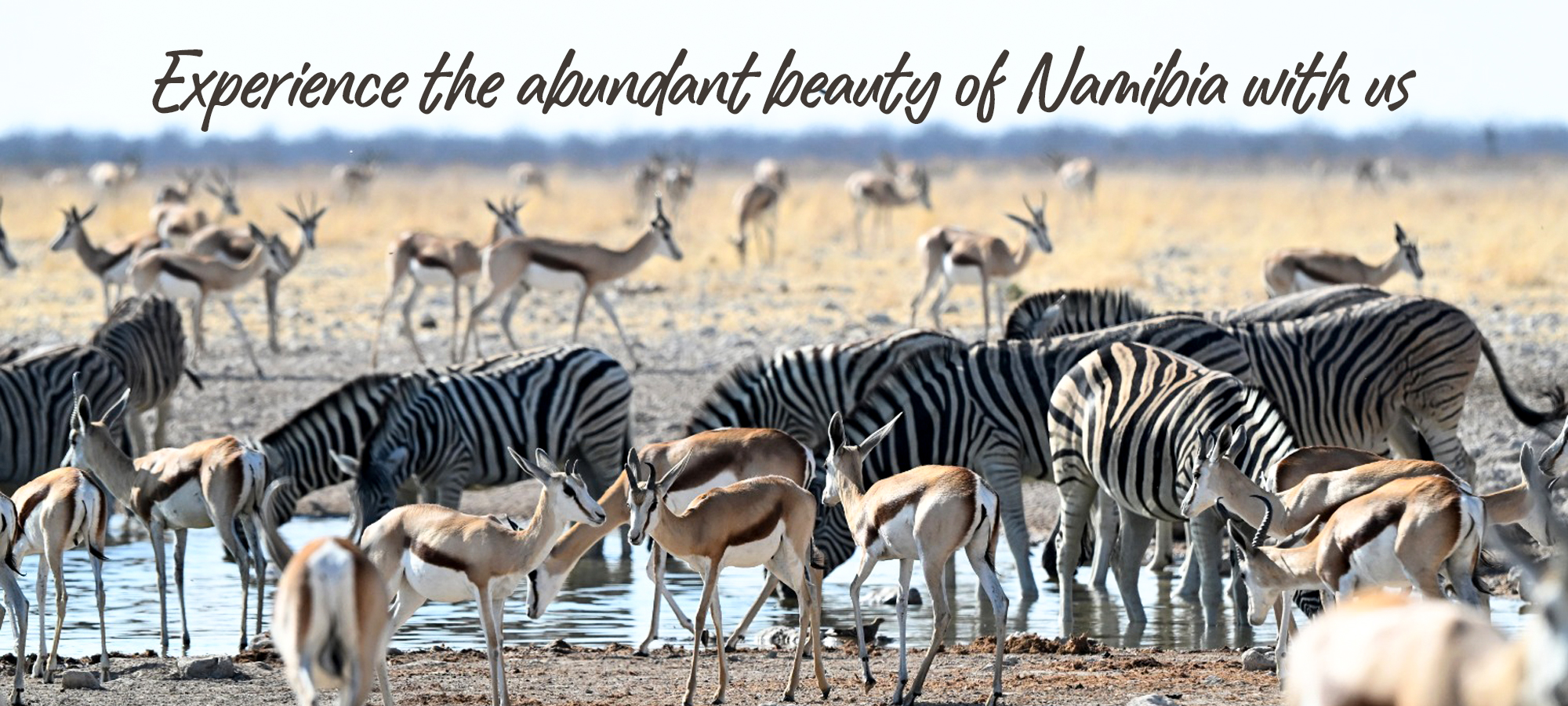
As with all the camps inside Etosha National Park, Halali has a waterhole where one can sit and watch the world go by. We spent our afternoon here and had Greater Kudu, Plains Zebra, Black Faced Impala, Springbok, Blue Wildebeest and common Duiker all come down for a drink!
I could think of worse things to be doing for an afternoon!
Dinner done and dusted, a quick coffee to warm us up. We headed to reception which was the meeting point for our night drive.
We hadn’t gone 300 m out the gate of Halali when we came across two male Lions walking down the road! Etosha was out to impress, and we had now ticked off the ‘Big 5’!

The next couple of hours would be made up of sightings of Elephants, Black backed Jackal, Black Rhino with a very young calf, Cape Fox, more Lions and the normal selection of ungulates all trying to get some sleep.
The following morning, we continued our trip westward across Etosha.
Picking up sightings of Greater Kudu, Red Hartebeest, Blue Wildebeest, Oryx, Steenbok, Springbok, Plains Zebra, Elephant, Black faced Impala and Black backed Jackal.
The highlight of the morning though goes to the Lions we found on a fresh Zebra kill. The two young males had eaten themselves into almost not being able to move but were still intent on keeping the numerous Jackals off of their kill.
We arrived at Okaukuejo in the late morning and decided to head out further west to find yellow mongoose. A slow drive through the right habitat and a bit of searching we found one. Another lifer ticked from the list!
After a quick lunch stop in Outjo we headed for Hobatere. A 320 Square km concession in the western part of Namibia.
The long afternoon in the car was worth every minute, as we arrived at Hobatere we had the desert adapted Elephants come and drink at the waterhole in front of the lodge they were shortly followed by a pride of 8 Lions! What an incredible welcome!
Some of the smaller mammals we were after are found in the area, one of these is the Striped tree squirrel and after getting a couple pictures of these cute little creatures we headed for dinner.
A troop of Chacma Baboons heading to their roost site in a large Ana Tree were the dinner entertainment. The scent of the Lions was obviously lingering on the breeze as the whole troop was rather nervous! The big male Baboon had to sort out a few of the younger members of the troop that weren’t doing what they were told, much to the amusement of the dinner gallery on the lodge deck.

Another night drive was on the roster for tonight, again we scored under the cloak of darkness with sightings of Cape Fox, Black backed Jackal, Lion, Springhare, Springbok, Small spotted Genet, Oryx, Brown Hyena and to top it all off we had an African Wild Cat hunting! Very productive to say the least!
Our next destination was the Brandberg where we would be staying at the White Lady Lodge, we bid farewell to the lovely tar roads and would now spend most of the remainder of our trip driving on the dirt!
On the way out of Hobatere I picked up fresh tracks of a very large male Lion on the road. We followed the tracks for almost 6 km down the road until they veered off into the bush. I was unable to locate him, but he was definitely watching us.
Brandberg White Lady Lodge – Swakopmund – Ondundu
We checked in, had a late lunch and then headed out for a drive in the area. Target animals were Suricate and Damaraland ground Squirrel. It’s a harsh environment and so the populations of wildlife in this area are sparse. It’s all about time on the ground and knowing the habitat.

We came across a small herd of Springbok grazing and shortly after this a pair of Steenbok.
Things went a bit slower from then on, but we soon hit pay dirt with the Suricates, a gang of 7 individuals actively foraging for food.
We arrived back at the lodge after dark. We sat down for dinner and discussed the plans for tomorrow, where would be the best area to get another lifer in the form of Damaraland Ground Squirrel.
Sunrise, breakfast … coffee. Although I think the order was more like Coffee, sunrise and then breakfast.
We started to make our way out the Ugab river valley and while driving we bumped into another Cape Fox, what an awesome start but not the target specie we were looking for.
Both species of Ground Squirrel are endemic to Southern Africa, however the Damaraland species has a much smaller distribution. They are also largely solitary which makes them harder to find, so it was a good thing we weren’t in a hurry.
Several hours later, after scanning rocky hillside after rocky hillside. We were beginning to get rather disappointed. Just as we were thinking of giving up, we found one!
Again, it’s all about the time one puts in to get what one wants!
Another lifer tick to add to the list!
Time to head to the Erongo mountains. Another one of my favourite places in Namibia.
After our lengthy morning spent locating the Damaraland ground Squirrel and a lunch stop at the quaint Hamlet of Uis, we arrived at Ondundu lodge. We settled into our accommodation, freshened up, grabbed binoculars, camera gear and headed out for a walk.
It wasn’t long before we were spotted by the local Chacma Baboon troop and their warning barks could be heard echoing off the mountains all around us.
Dassie Rat, Bushveld Sengi and Steenbok made up the remainder of the afternoon’s sightings.


During dinner we watched a prickle of Porcupines (I love collective nouns for animal groups!) come down to the small waterhole in front of the lodge, Mom, Dad and a little one. What a treat but we weren’t quite finished, during dessert there was a Small spotted Genet that also came to pay us a visit. I guess you could say it was a dinner with some uniquely African guests.
The next day would see us heading down to the coastal town of Swakopmund, here we would be heading out to do a boat trip from Walvis Bay.
It’s harder to get a more diverse scenery change than going from the desert to the ocean but this is exactly what we did.
Our boat trip gave us Cape Fur Seal and another mega the Heaviside Dolphin. This Dolphin is the smallest of its species in the region and restricted to the cold waters of the Benguela Current off Southern Africa’s west coast! Another great ‘lifer’ to get.
The sun rose on the final day of our trip. We made our way slowly back towards Windhoek, but we made a short stop at the majestic Spitzkoppe to see if there was anything of interest there. We got sightings of Rock Hyrax but the small group of Klipspringer that call the place home eluded us.
All in all, we got a total of 58 mammal species in our 14 days around Namibia. Nearly 50% of these were lifers for the guest.
A very respectable total that I am very proud of!
I am looking forward to the next Namibian mammal tour and I hope you will be joining me.
Full list of species:
Bushveld Sengi – Elephantulis intufi
Pygmy hairy-footed Gerbil – Gerbillurus paeba
Elephant – Loxodonta africana
Rock Hyrax – Procavia capensis
Southern Lesser Galago – Galago moholi
Malbrouck Monkey – Chlorocebus (Cercopithecus) cynosuros
Chacma Baboon – Papio ursinus
Cape Hare – Lepus capensis
Scrub Hare – Lepus saxatalis
Savanna Hare – Lepus microtis
Springhare- Pedetes capensis
Porcupine – Hystrix africaeaustralis
Dassie Rat – Petromus typicus
Tree Squirrel – Paraxerus cepapi
Striped Tree Squirrel – (Funisciurus Confucius)
Southern African Ground Squirrel – Xerus inauris
Damara Ground Squirrel- Xerus princeps
Cheetah – Acinonyx jubatus
African Wild Cat – Felis silvestris cafra
Lion – Panthera leo
Leopard – Panthera pardus
Yellow Mongoose – Cynictis penicillata
Banded Mongoose – Mungos mungo
Slender Mongoose – Galerella (Herpestes) sanguinea
Suricate (Meercat) – Suricata suricatta
Brown Hyena – Hyaena brunnea
Small Spotted Genet – Genetta genetta
Large Spotted Genet – Genetta maculata
Black Backed Jackal – Canis mesomelas
Bat eared Fox – Otocyon megalotis
Cape Fox – Vulpes chama
Cape fur Seal – Arctocephalus pusilus
Ground Pangolin – Smutsia (Manis) temminckii
Plains Zebra – Equus quagga
Hartmans mountain Zebra – Equus zebra hartmannae
White Rhino – Ceratotherium simum
Black Rhino – Diceros bicornis
Common Warthog – Phacochoerus africanus
Hippopotamus – Hippopotamus amphibious
Impala – Aepyceros melampus
Black faced Impala – Aepyceros melampus petersi
Red Haartebeest – Alcelaphus (buselaphus) caama
Springbok – Antidorcus marsupialis
Blue Wildebeest – Connochaetes taurinus
Tsessebe – Damaliscus lunatus
Sable – Hippotragus niger
Waterbuck – Kobus ellipsiprymnus
Red Lechwe – Kobus leche leche
Damara Dik Dik – Madoqua damarensis
Oryx – Oryx gazella
Steenbok – Raphicerus campestris
Common Duiker – Sylvicapra grimmia
Bushbuck – Tragelaphus sylvaticus
Greater Kudu – Tragelaphus strepsiceros
Giraffe – Giraffa camelopardalis
African Buffalo – Syncerus caffer
Haviside Dolphin – Cephalorhynchus heavisidii
Straw-coloured Fruit-bat – Eidolon helvum
Sundevall’s Leaf-nosed Bat – Hipposideros vittatus
Photo Credit: Buzzy Joell and Judy Parrish