Kunene

We here at Nature Travel Namibia love our country and its stunning landscapes. One of our favourite areas to visit is the pristine and remote Kunene region.
Travel to Namibia and visit Kunene with Nature Travel Namibia

Kunene is one of the fourteen official regions of Namibia and is located in the far northwestern corner of the country. It is roughly 115 260 square kilometres (44 500 square miles) big, with a population density of only 0.75 people per square kilometre (2 per square mile)!

Kunene’s western edge is the shores of the Atlantic Ocean. In the north, it borders Angola’s Namibe Province, and in the far eastern part of its northern edge, it borders Cunene Province. Compared to the rest of Namibia, it is relatively underdeveloped. This is due to the mountainous inaccessible geography and the dryness that significantly hinders agriculture.

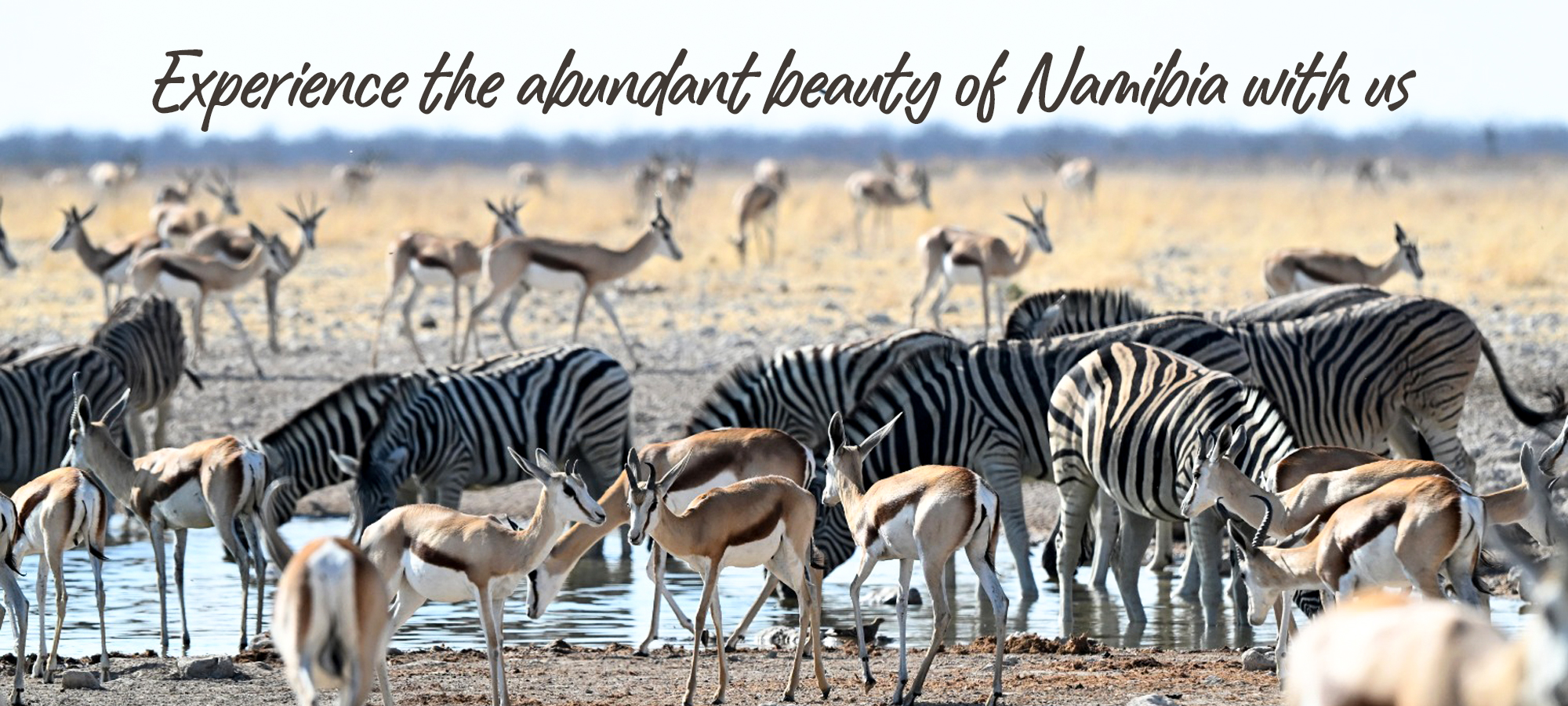
It is home to an abundance of wildlife. A wealth of African Elephant, Lion, Cheetah, Leopard, Spotted Hyaena, Hartmann’s Mountain Zebra, Springbok and Gemsbok roam here. This is also home to the largest population of free-ranging Black Rhinoceros in the world.
Gemsbok in Namibia, Kunene with Nature Travel Namibia

The region’s name comes from the 1050 kilometre (650 miles) long perennial Kunene River, which forms the northern border with Angola. It flows from the Angola highlands south to the border with Namibia, and then west along the border until it reaches the Atlantic Ocean. The dramatic and beautiful Epupa Falls lies on the river and is a popular tourist attraction. There are all sorts of exciting activities to enjoy on and along the river, from boat cruises and canoeing to white-water rafting and fishing.
It is also a birdwatching hotspot, with many localised and highly prized species occurring here.

The largest town and capital of the region is Opuwo. It is the only bigger town to be found in the Kunene region and is an ideal stopover when travelling north to the Epupa Falls. The only airport in the region is found here, offering the option of fly-in safaris.

The Kunene region is home to the Himba tribe who seem to thrive in this stark desert landscape. The Himba people, one of the last true nomadic tribes on Earth, is a highlight on any visit to the area, with their intricate customs, ochre-covered bodies, jewellery and skins.

There are many other attractions in this fascinating region to enjoy, from dedicated wildlife conservancies to informative cultural museums and thrilling 4×4 adventure trails. We offer trips to the dramatic Kunene region as part of our self-drive or guided Namibia safaris.
Travel to Namibia and visit Kunene with Nature Travel Namibia

For more information on these trips or to customise your itinerary, get in touch at info@naturetravelnamibia.com

Namibian Coastline Experience

A visit to the Namibian Coastline includes a bit of everything, from the Cape Cross Seal Reserve, visits to Henties Bay & Swakopmund and birding in Walvis Bay.

“You need to lose yourself and disappear in the depths of the repetitions? Find a coast and watch the repetitive waves! Soon your mind vanishes away and when your mind disappears you disappear!” (Mehmet Murat ildan).

But waves are not only what the Namibian coastline can offer. On some of our Nature Travel Namibia safaris, we visit the Cape Cross Seal Reserve, stop over in Henties Bay, see shipwrecks, stay over in Swakopmund and watch birds in Walvis Bay.

The Cape Cross is the largest Seal Colony in the world and there are 24 colonies on the Namibian and South African coastline. When one gets here, some visitors find the smell not so pleasant hence wear mouth covers whereas some like myself have become immune to it! Very interesting is the remoteness of the area and thousands of Seals. Their vocals range from goat-like bleating, high pitched cackles to half human and braying laughs. Males have these deep voices sort of a bass developed from years of a combination of smoking, drinking whisky and yelling! However, it creates quite an awesome experience as one gets pretty close to them. A couple of times I have seen guests laughing at the vocals and its best to take a video for memories!

Swakopmund gives one the real beach Three Rs (Rest, Relax and Reflect) feeling. It’s best to spend 2 nights here and get time to go for a morning jogging along the beach and explore the area on foot in the afternoon. The Strand Hotel and Swakopmund Sands Hotel are normally our preferred accommodations, which gives one the town feeling after some time in the real African wilderness offered by Namibia’s remote areas.
Walvis Bay has a lagoon that is a must for enthusiastic birders. Here one could see thousands of Flamingoes showing off their beautiful and contrasting pink, black and white feathers in flight or doing their dance while feeding in shallow waters. Great White Pelicans can be seen resembling an amphibious aircraft taking off and landing both on conventional runways and water. Various other species of water birds can be observed as well depending on the season.

Flamingo.jpg

At Walvis Bay, the Catamaran tour is definitely worth it. On one of my safaris with Nature Travel Namibia, we were taken out by a local guide, Peter, who is well versed in the history of Walvis Bay and marine life. We had uninvited guests on the catamaran as well: Seals and Great White Pelicans. We made a turn to the Oil Rig before enjoying our lunch on the boat, which comprised mainly of sea food. What an experience!
Join Nature Travel Namibia on safari to experience the beautiful coastline and so much more! Visit www.naturetravelnamibia.com for more information.  (Written by Previous Tsvigu (Nature Travel guide))

Damaraland

Nature Travel Namibia offers tours to most parts of the wonderful country of Namibia, but most of our tours go to the area known as Damaraland, and with very good reason!

Damaraland is a region in the north-central part of the country, bounded to the west by the Atlantic Ocean, to the east by the Kalahari desert, to the north by Kaokoland, and to the south by the Great Namaqualand. It is a visually dramatic area, with rugged rocks, prehistoric water courses, open plains and grassland, massive granite koppies and deep gorges. Get your cameras ready!

Damaraland (2)
Damaraland is alternatively known as Hereroland, both names being derived from the local people inhabiting the region. The so-called Damara consist of two probably distinct peoples, known respectively as “the hill Damara” and “the cattle Damara,” i.e. those who breed cattle in the plains. The term Damara (“two Dama women”) is of Hottentot origin, and is not used by the people, who call themselves Ova-herero, “the merry people”. The name Damaraland is still commonly used in tourism circles, although the entire region has now been renamed; the southern section now lies in the Erongo region while the north forms part of the Kunene region.
This beautiful mountainous region is home to an assortment of scientifically important desert-adapted wildlife such as Elephant, Rhino, Zebra and Lion, which somehow survive and thrive in this near-barren landscape.

Damaraland (3).jpg

We offer tours that focus specifically on these incredible animals, tracking them on foot, with our sister company Nature Travel Conservation.

Another not-to-be-missed attraction of the Damaraland area is the picturesque Brandberg (fire mountain), Namibia’s highest mountain at 2573m, which is home to thousands of ancient rock paintings, most notably the White Lady.

Damaraland (1).JPG

The rocky outcrops of Twyfelfontein is another top-notch attraction, and one of Namibia’s two UNESCO World Heritage Sites, featuring exceptional Bushmen engravings, which are considered to be some of the best-preserved etchings on the continent.
The Spitzkoppe (sharp head) is one of Namibia’s most recognizable landmarks. It’s shape has inspired its nickname, “The Matterhorn of Africa”, but the similarities begin and end with its sharp peak. It is actually the remnant of an ancient volcano, formed in the same way as the Brandberg and Erongo massifs. It was first climbed in 1946 and is now a popular climbing destination with local and foreign mountaineers alike, with plenty of technical climbs available.

There are several other important geological rock formations nearby that are not to be missed, including the “organ pipes” arrangement (a distinctive series of dolerite pillars that have been exposed by erosion), the petrified forest (believed to be more than 200 million years old) and the much-photographed “burnt mountain” (a flat-topped mountain that derives its name from the piles of blackened limestone at its base).

Damaraland (4)

Join us in beautiful Damaraland to see all these attractions and make indelible memories on one of our Namibia safaris here at Nature Travel Namibia.

Sossusvlei


Situated in the largest conservation area in Africa (the Namib-Naukluft National Park), Sossusvlei is possibly Namibia’s most spectacular and best-known attraction. Characterised by the large red dunes that surround it, Sossusvlei is a large, white, salt and clay pan and is a great destination all year round.

The dunes in this area are some of the highest in the world, reaching almost 400 meters, and provide photographic enthusiasts with wonderful images in the beautiful morning and evening light. The characteristic red dunes of the Namib Desert have developed over many millions of years. The red sand that forms the dunes was deposited into the Atlantic Ocean from the Orange River. The Benguela current then carried this sand northwards, to be deposited back onto the land by the ocean’s surf. From here the wind carried the red sand inland to form the dunes over time.

Sossusvlei (5)

Sossusvlei literally translates to “dead-end marsh”, as it is the place where the dunes come together preventing the Tsauchab River from flowing any further, some 60km east of the Atlantic Ocean. However, due to the dry conditions in the Namib Desert the river seldom flows this far and the pan remains bone-dry most years. During an exceptional rainy season the Tsauchab fills the pan, drawing visitors from all over the world to witness this spectacular site. Photographic enthusiasts are spoilt with a glassy “lake” holding reflections of the surrounding dunes. When the pan fills it can hold water for as long as a year.


Despite the harsh desert conditions in the area, one can find a wide variety of plants and animals that have adapted to survive. These include insects, reptiles, birds, mammals and many desert adapted plants, flowers and fruits, like Namibia’s national plant, the welwitschia.
There are a number of attractions around Sossusvlei for visitors to explore, including
• the spectacularly carved-by-water Sesriem Canyon
• Dune 45, the most photgraphed dune on earth, situated 45 km past Sesriem on the road to Sossusvlei
• Hiddenvlei, perfect if you are looking for solitude in the desert
• the magnificently tall Big Daddy dune
• Deadvlei, a paradise for photographers, as it is punctuated by blackened, dead acacia trees, in vivid contrast to the shiny white of the salty floor of the pan and the intense orange of the dunes.

Accommodation around Sossusvlei ranges from camping, through self-catering and mid-range lodges, to the ultimate in luxury lodges. This allows visitors to the area to find accommodation that meets their needs. No matter where you stay, the vastness of the desert allows for ample space and privacy.
As a consequence of its fascinating and surrealistic landscapes, Sossusvlei is one of the most photographed places in Sub-Saharan Africa. The area has been the setting of a number of commercials, music videos, and movies, especially of the fantasy genre.

To see this incredible natural wonder for yourself, visit us at http://www.naturetravelnamibia.com.  We have numerous guided and self-drive options for you to choose from, and many of our Namibia tours include this famous area.

The master architects – Termite Mounds

Termite Mound.jpg

When one drives in Namibia, especially areas from the north and central parts of the country, you will encounter towering hard compacted soil structures sprouting across the landscape mostly pointing north. These usually attract our guests’ attention consequently with a question, “What is that?” They are termite mounds, better known as anthills!

Biology of the termites have been thoroughly studied and well documented, of particular interest is the significance of the termite mounds and the social organisation of termites that can be related to real human lifetime events!

Termite mounds are huge thermostats. Temperature and humidity is regulated by opening and closing of openings, which is done by the worker termites during night time, which is why every morning one sees wet patches of repairs done. Climatic change is a global concern, hence some studies in the Otjozondjupa Region reveal that structure of the mounds could contribute to knowledge on building energy efficient houses. This is one of the strategies that could help minimise and protect against the increasing impacts of climate change.   The human equivalent of termite mounds would be buildings that meet all energy, waste management and other needs on site. No other organism on the earth is known to engineer the environment to this level, definitely not humans!

For years, the term “true democracy” has remained arbitrarious or non-existent in the human race. Amazingly it’s real in a termite colony! The king, queen, workers and soldiers are at the same level, there is no superiority, but it is just division of labour, where each has different roles to play. The queen and king have their royal palace underground, mating and managing 2000 eggs per day. The army consists of soldier termites that are strongly built and armed (strong mouth parts), implying a  good ground force to fight other insects. However, termites have a poorly managed air force department for attacking bigger giants e.g. Aardvark, Aardwolf, Bat-eared Fox, insectivorous birds, and hence these prey heavily on them.

Once either workers or soldiers die during the course of carrying their duties, they send a stress chemical signal to the queen, who in turn produces more eggs to meet the daily labour and army requirements. Differentiation into either worker or termite is determined by the population in each group. The workers assignments include being undertakers (remove dead bodies to avoid disease spread) or architects (designing and construction of the colony structure). More importantly they are also mycologist (develop fungi) to feed everyone in the colony. Fungus spores grow into mushrooms which are a local Namibian delicacy known by their Herero name: Omajova. Omajova grow after good rains, offering a convenient food delicacy plus ensuring an income to local sellers who usually stand on the sides of the main roads between cities.

Termite mounds can actually be compared to Windhoek! Streets are in the form of channels underground. The population size is half a million to a million individuals. How do they counter the problems of overpopulation and spread the genes to other areas? Workers and soldiers change into flying forms which appear during the rainy season and attempt to establish their own colonies. 99 % of these do not make it as they suffer predation by a range of animals, more important eaten by humans as well.

The combination of the mineral-rich soils and saliva, and the organic wastes from the fungus colony make termite mounds a very fertile place in an often otherwise infertile environment. Thus termites are actually farmers too, as trees often grow on termite mounds, even inactive ones. In wetlands like the Okavango Delta termites are also very important long-term landscapers. Over the years, termite mounds rearrange the flows of streams and form fertile islands.

They really are incredible insects and as you can see, can be described as anything from builders, engineers, architects, soldiers, farmers and more. To come and see a termite mound and its inhabitants close up, join us on a Namibian safari!

Have a look at the options on www.naturetravelnamibia.com or enquire directly as info@naturetravelnamibia.com